
Improve posture and reduce upper-back stiffness with this short Iyengar Yoga sequence of nine essential poses designed to open the chest, strengthen the upper back, and support balanced spinal alignment.
9 Essential Yoga Poses to Improve Posture
Poor posture has become increasingly common in modern life. Long hours spent sitting at desks, working at computers, or looking down at mobile devices often lead to habitual rounding of the upper back, tightening across the chest, and a forward positioning of the head and shoulders. Over time these patterns can contribute to stiffness in the thoracic spine, tension in the neck and shoulders, and a reduced ability for the spine to support itself in an upright and balanced way.
Yoga offers a practical and effective way to address these issues. By combining mobility work for the chest and upper back with strengthening of the legs, core, and spinal muscles, a well-structured yoga sequence can help restore balance across the entire body. Rather than focusing on a single area, improving posture requires an integrated approach that encourages the spine to lengthen upward while the surrounding muscles provide stable and sustainable support.
The class presented below is a 40-minute sequence of nine essential yoga poses designed to improve posture. The practice focuses on opening the chest, reducing stiffness in the upper back, and repositioning the shoulder girdle into a more balanced alignment. At the same time, the sequence strengthens the legs so they can better support the lift of the spine, reinforces the abdominal wall to stabilise the lumbar region, and develops the paraspinal muscles that help maintain healthy spinal curves.
Designed to be accessible for newer practitioners while still offering meaningful work for more experienced students, the class addresses posture from multiple perspectives – mobility, strength, and body awareness. The step-by-step pose breakdown that follows highlights the key actions used in the sequence so you can better understand how each pose contributes to improving posture and overall spinal health.
Table of Contents
- 9 Essential Yoga Poses to Improve Posture
- Overview of the 9 Pose Sequence
- Pose 1 — Reclining Over Two Blocks (Upper Back & Neck Traction)
- Pose 2 — Tadasana with Belt (Upright Standing Alignment)
- Pose 3 — Virabhadrasana I with Belt (Leg Strength & Spinal Lift)
- Pose 4 — Salabhasana Variation with Belt (Upper Back & Paraspinal Strength)
- Pose 5 — Ustrasana Variation with Chair (Shoulder Mobility & Upper Chest Opening)
- Pose 6 — Upward Facing Dog with Chair (Balanced Spinal Extension)
- Pose 7 — Purvottanasana with Chair (Posterior Strength & Front-Body Opening)
- Pose 8 — Plank with Blocks (Core Stability & Spinal Support)
- Pose 9 — Chatushpadasana (Supported Bridge for Strength & Chest Opening)
- Deepen Your Practice: 8-Part Yoga for Poor Posture Course
- Class 1: Yoga Poses Using a Doweling Prop
- Class 2: Yoga Poses for Correcting Poor Posture
- Class 3: Core Strength for Spinal Stability
- Class 4: Standing Poses and Backbends with a Looped Belt
- Class 5: Yoga for the Upper Back
- Class 6: Yoga for the Upper Back and Shoulders
- Class 7: Yoga Poses for Office Workers
- Class 8: Supported Yoga for Chest and Upper Back Opening
- Frequently Asked Questions
- Take Your Posture Practice Further
Yoga Poses for Improving Posture (Free 40-Minute Class)
The class below presents a concise sequence of nine poses designed to open the chest, strengthen the back body, and restore balance to the spine.

Improve Your Posture with Structured Iyengar Yoga
Continue your posture journey with the full Yoga for Poor Posture course.
These carefully structured classes help you open the chest, strengthen the upper back, and restore healthy spinal alignment through clear, methodical instruction.
Your membership includes full access to this course, over 900 on-demand classes, and Yoga Selection’s entire library of structured yoga courses.
Clear Instruction. Intelligent Sequencing. Iyengar Yoga for Every Body.
Overview of the 9 Pose Sequence
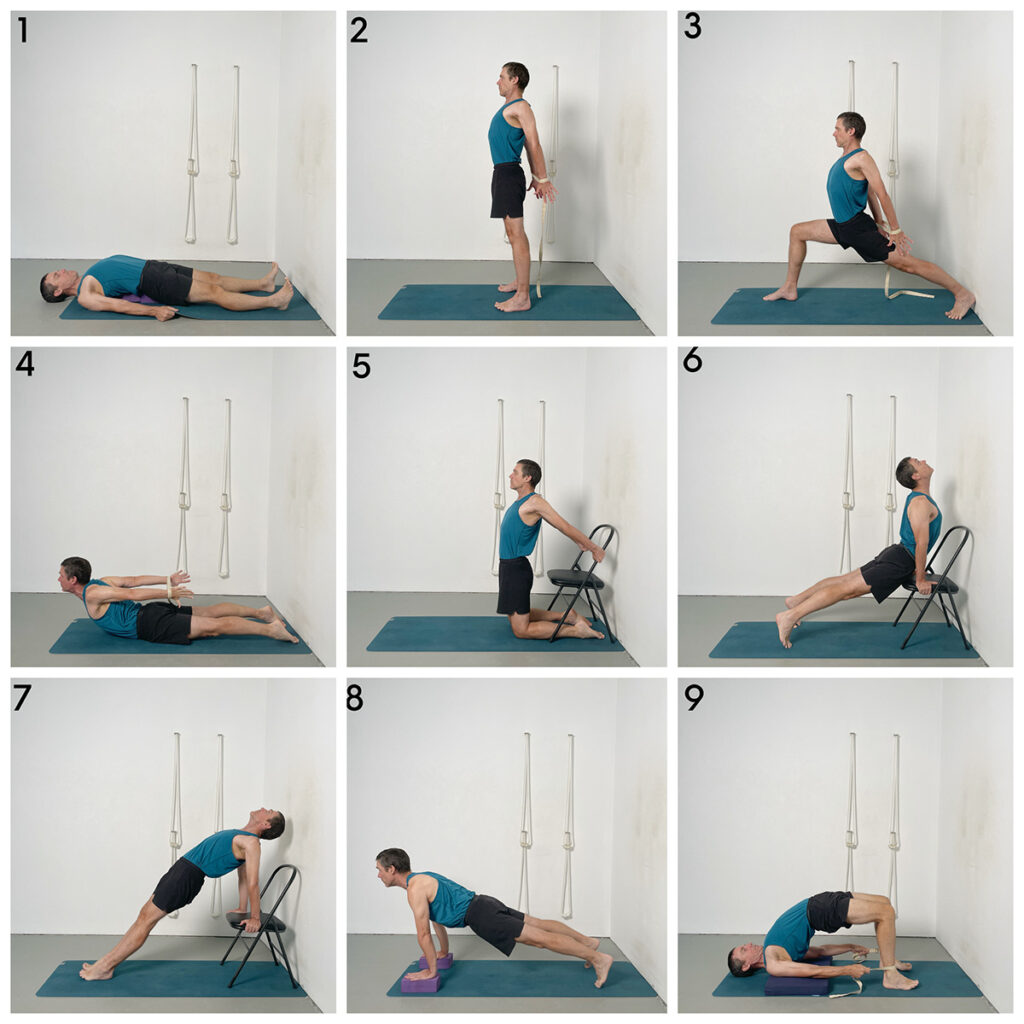
The sequence below combines chest-opening poses, upper-back strengthening, and core stabilisation to help restore balanced spinal alignment.
Pose 1 – Reclining Over Two Blocks (Upper Back & Neck Traction)
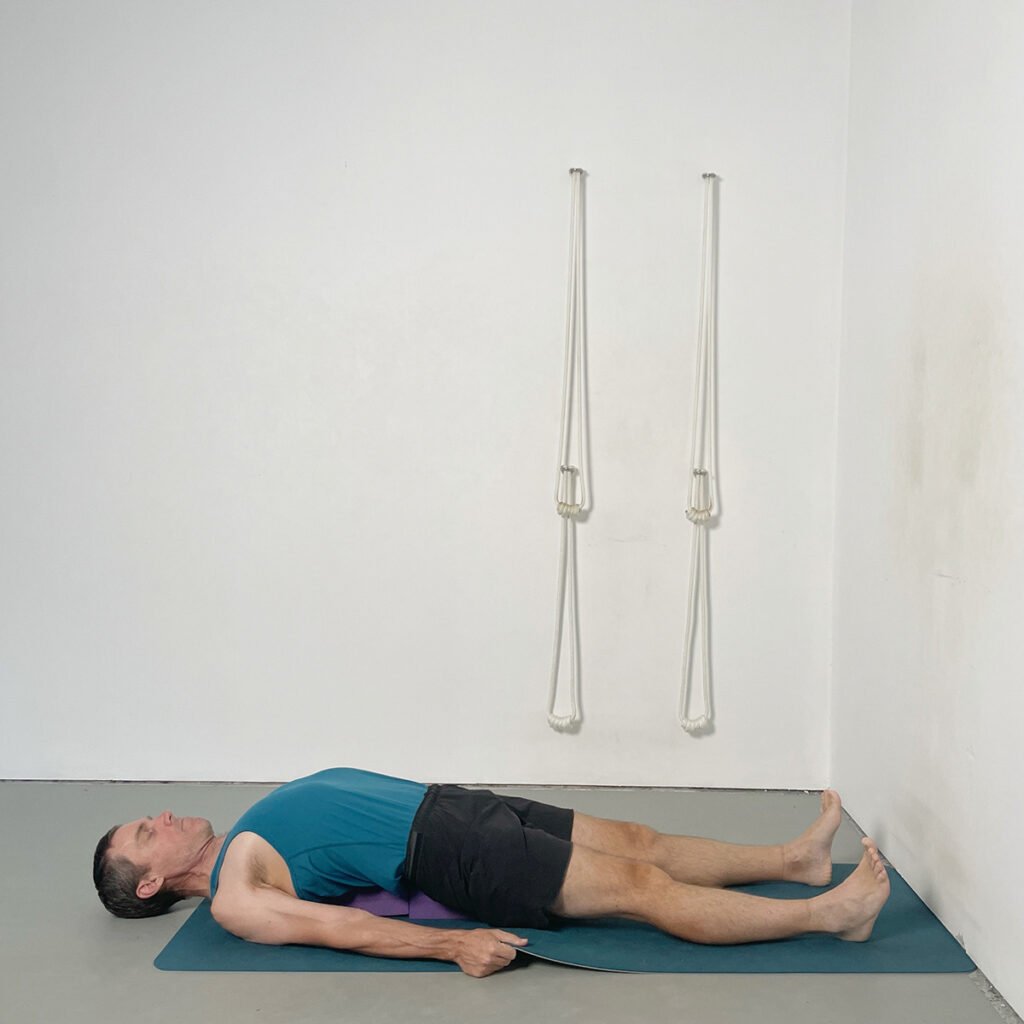
This reclining variation uses two blocks placed end-to-end to create a precise adjustment at the base of the neck and upper thoracic spine. It is particularly effective for counteracting forward head posture and stiffness in the upper back — two common contributors to rounding through the thoracic spine and collapse across the chest. The pose is approached in three stages. First, the C7 vertebra (the base of the neck) is positioned at the edge of the blocks so the blocks can gently draw the trapezius region away from the neck. Second, the body slides slightly so that T2 aligns to the block edge, corresponding with the top of the shoulder blades. This stage increases the traction effect, helping to reposition the shoulder girdle and gradually lengthen the back of the neck without strain. In the final stage, the backs of the shoulders lightly meet the floor and the legs straighten, allowing the blocks to work more firmly into the upper back and improve thoracic mobility. Practiced consistently, this variation helps retrain the relationship between the chest, shoulders, and head, encouraging the chest to sit higher and the head to align more naturally over the torso in upright standing.
Instructions:
- Place two blocks end-to-end on your mat, leaving a small gap beyond the blocks for the back of your head to rest comfortably on the floor.
- Lie back with knees bent and feet flat. Position the back of the head on the floor and keep the shoulders initially off the floor.
- Stage 1 (C7): Locate the C7 vertebra (the prominent bone at the base of the neck) and align it precisely with the edge of the blocks. This placement is more important than where the pelvis rests.
- Press the feet firmly into the floor, as if stretching the mat away from the blocks. Feel the blocks draw the trapezius and upper back tissue away from the neck.
- Keep the chin gently moving toward the throat (avoid over-lifting). Lengthen the back of the skull away from the upper back.
- Stage 2 (T2): Lift the hips slightly and slide back so that T2 (two vertebrae below C7) aligns with the block edge — approximately level with the top of the shoulder blades. Repeat the same foot action and maintain the subtle chin adjustment.
- Stage 3: Walk the feet slightly closer and press down to slide back until the backs of the shoulders just lightly contact the floor, maintaining the traction effect through the upper back rather than losing it by moving too quickly.
- Straighten the legs one at a time, ankles hip-width apart, allowing the legs to turn slightly out. Keep the chin softly drawn in.
- To maintain traction once the legs are straight, hold the side edges of the mat near the hips and gently stretch the mat toward the wall, pinning the shoulders back and broadening the upper chest.
- Maintain steady, quiet breathing and allow the blocks to create mobility through the upper thoracic spine while the neck remains long and unforced.
Pose 2 – Tadasana with Belt (Upright Standing Alignment)
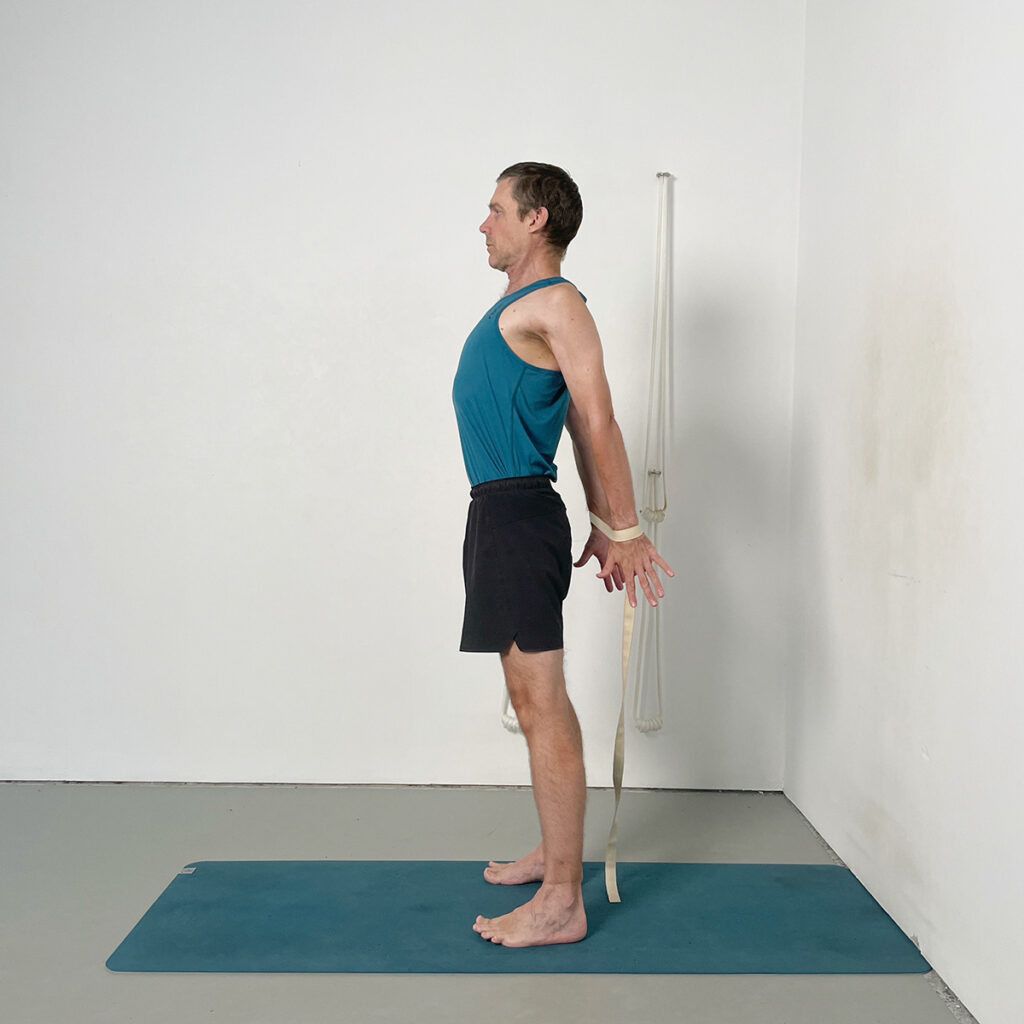
This standing variation uses a looped belt around the wrists to improve your ability to access balanced postural alignment in Tadasana. Pressing outward into the belt with straight elbows helps you draw the shoulder blades inward and reposition the shoulder girdle without collapsing the upper back. The action encourages the chest to lift while the trapezius softens downward, helping to counter the common tendency for the shoulders to round and the head to drift forward of the torso. At the same time, careful leg work stabilises the pelvis and supports the natural curves of the spine. Practiced attentively, this pose reinforces upright alignment from the feet upward, integrating lower-body stability with upper-body openness.
Instructions:
- Create a loop in your belt so that when placed around the wrists, it keeps them shoulder-width apart when pressing outward with straight elbows.
- Stand in Tadasana with feet hip-width apart, weight evenly distributed between the front and back of the feet.
- Lift the kneecaps without pushing the shins back. Keep the front thighs steady as you draw the back of the pelvis inward and the tailbone down. Allow the legs to support the lift of the spine.
- Place the belt around the wrists behind the back. Press outward into the belt with straight elbows.
- Roll the shoulders back and begin to lift the chest. Notice the shoulder blades moving inward.
- Initially press more through the thumb side of the wrist, then balance this by pressing through the little finger side, allowing both the inner and outer portions of the shoulder blades to move evenly into the body.
- Lift not only the center of the chest but also the sides of the chest, maintaining breadth across the collar bones.
- As the chest lifts, allow the belt, arms, and trapezius to move downward, preventing the shoulders from creeping toward the ears.
- Keep the chin gently moving toward the throat, maintaining the natural curve of the neck without exaggeration.
Pose 3 – Virabhadrasana I with Belt (Leg Strength & Spinal Lift)
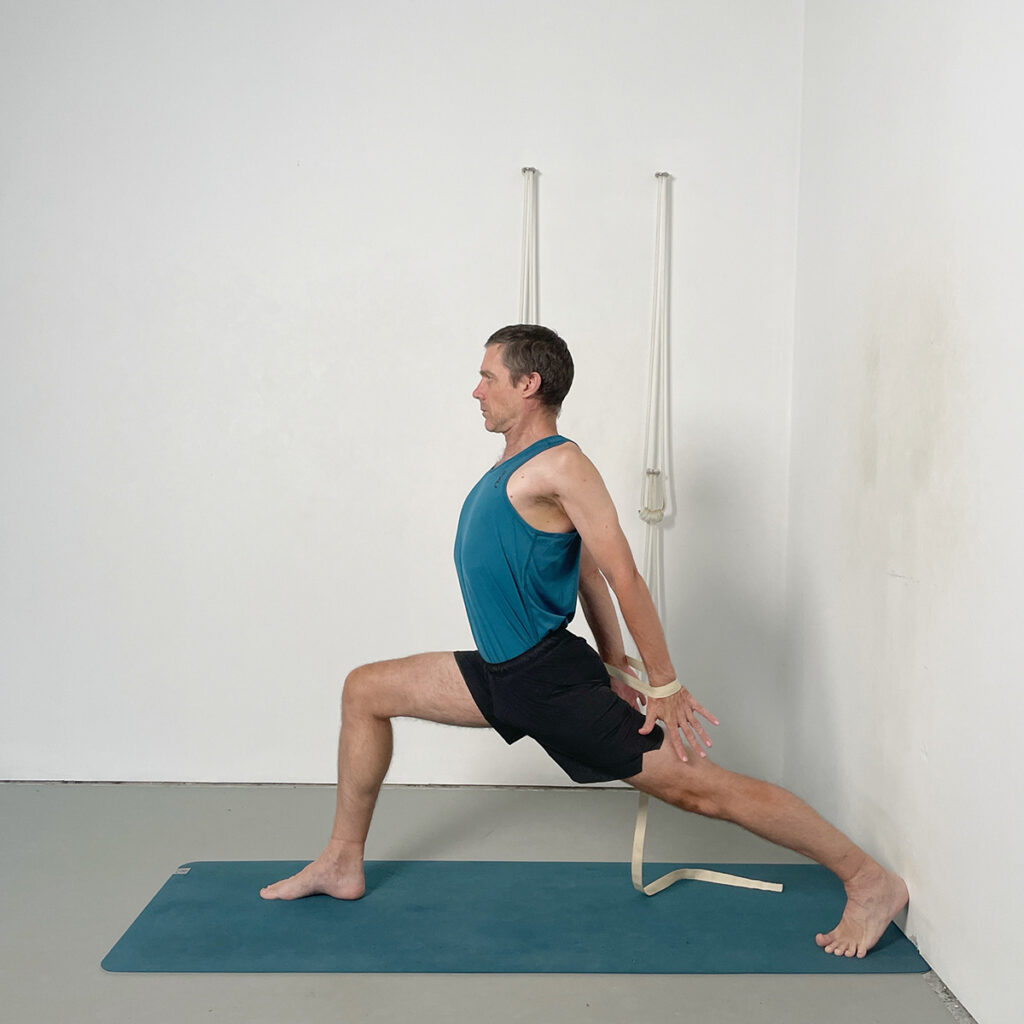
This variation of Virabhadrasana I builds on the standing belt work by adding a strengthening component through the legs. Strong, active legs are essential for good posture — they allow the spine to lift naturally against gravity rather than compressing into the pelvis and lower back. By bending the front leg and pressing the back heel firmly toward the wall (with the heel slightly lifted), the back leg straightens and draws the back of the pelvis inward. This action supports the lift of the front pelvis and chest. At the same time, pressing outward into the belt helps move the shoulder blades into the body and broaden the upper chest, preventing excessive strain in the lower back. The pose teaches how lower-body stability and upper-back engagement work together to create sustainable upright alignment.
Instructions:
- Keep the belt looped around the wrists behind the back, maintaining shoulder-width distance.
- Step into a leg-length stance. Lift the back heel slightly (about 2–3 cm) so it can press firmly back into the wall rather than straight down.
- Bend the front knee, allowing the thigh bone and hip socket to sink.
- Press the back heel strongly into the wall and straighten the back knee. Feel the back buttock move inward and the front of the pelvis begin to lift.
- Notice the natural tendency for the lower back to bend. Allow this, but ensure the upper back also moves inward so the work is shared evenly.
- Press outward into the belt with straight elbows.
- Balance the pressure between the thumb side and little finger side of the wrists, allowing the entire shoulder blade to move deeper into the body.
- Lift not only the center of the chest but also the sides of the chest, while keeping the shoulders and trapezius moving downward.
- Maintain a gentle chin-to-throat action, keeping the neck long and aligned.
- Repeat on the second side, preserving the same relationship between strong legs and lifted chest.
Pose 4 – Salabhasana Variation with Belt (Upper Back & Paraspinal Strength)
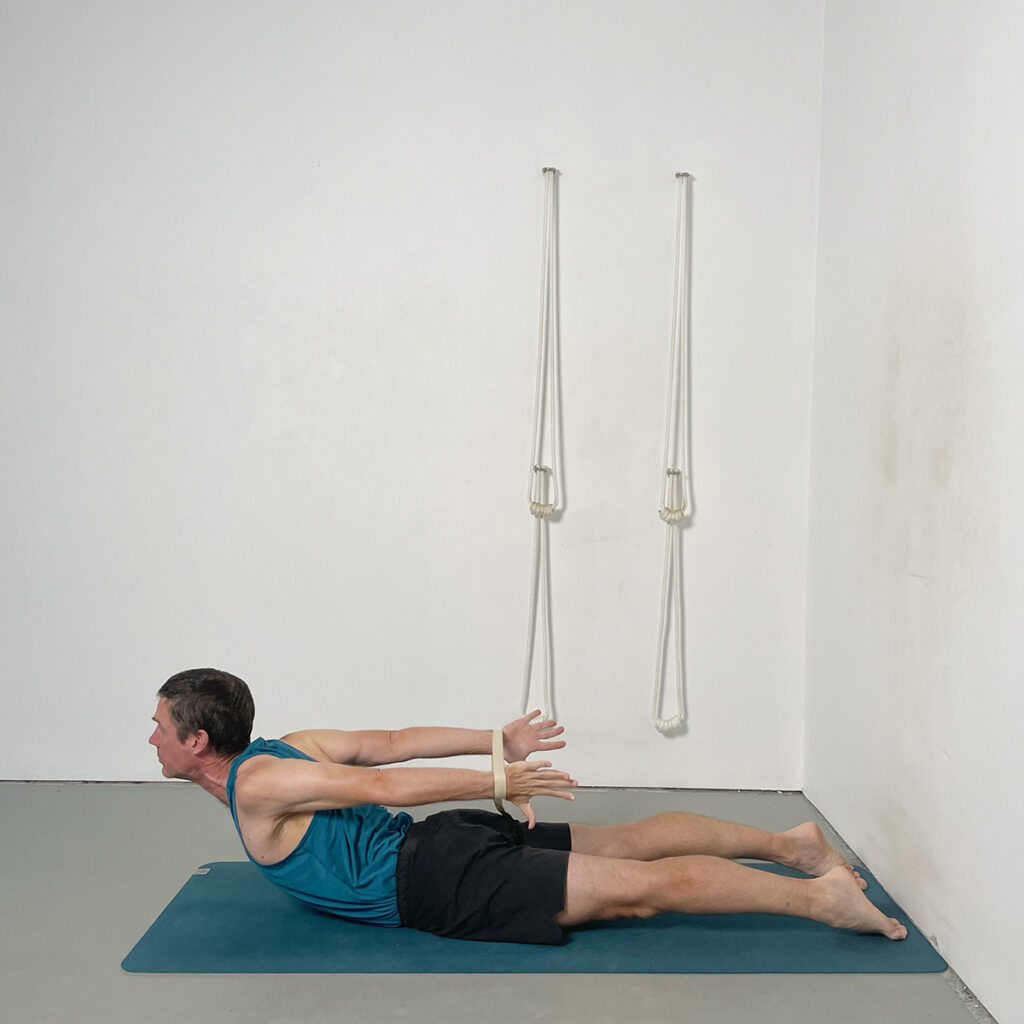
This variation of Salabhasana strengthens the paraspinal muscles that support the spine and help maintain upright posture. Whereas the previous poses mobilised and repositioned the upper back and shoulders, this pose develops the muscular strength required to sustain that alignment. By pressing the front of the pelvis firmly into the floor, the lower back is stabilised so that the lift of the chest and head can be distributed more evenly through the entire spine. The looped belt around the wrists assists in drawing the shoulder blades into the body, encouraging the upper back to participate in the lift rather than overloading the lumbar region. Strengthening the muscles on either side of the spine – particularly in the upper thoracic area – improves the body’s ability to resist forward collapse and maintain a lifted chest without strain in the neck.
Instructions:
- Lie face down, ensuring you are far enough from the wall so the feet do not touch it when the legs are straight.
- Place the belt loop around the wrists behind the back, palms parallel (thumbs turning down, little fingers up).
- Feet hip-width apart. Press the tops of the feet firmly into the floor and straighten the knees.
- Press the front of the pelvis evenly into the floor, beginning at the pubic bone and spreading that grounding action across the front hips.
- Lift the head, shoulders, and arms together.
- Press outward into the belt and move the shoulder blades inward, allowing the upper back to assist the lift.
- Emphasise the little finger side of the wrist so the whole plate of each shoulder blade moves into the body evenly.
- As the chest moves forward and upward, allow the arms and belt to move slightly back, keeping the trapezius descending away from the neck.
- Lift the head only as high as you can without compressing the lower back.
- Lower with control and repeat as needed.
Pose 5 – Ustrasana Variation with Chair (Shoulder Mobility & Upper Chest Opening)
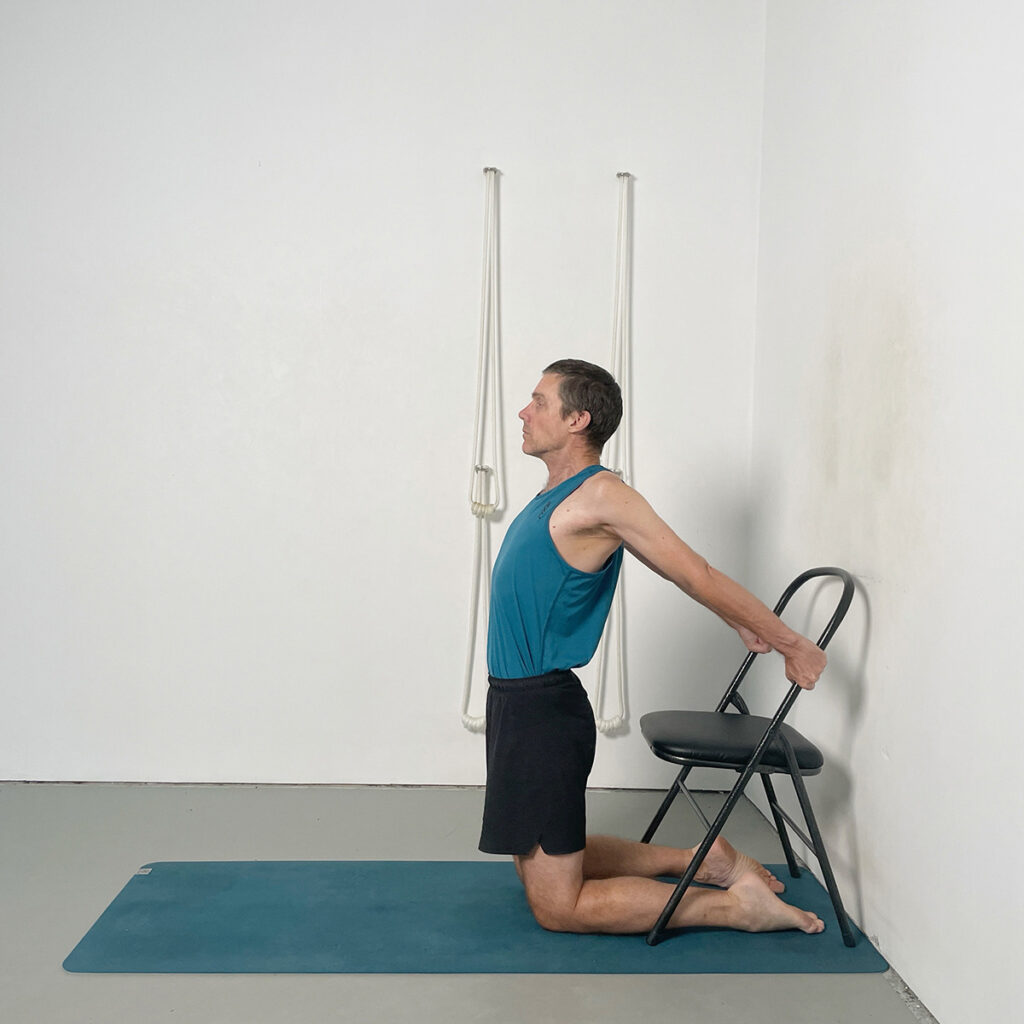
This supported variation of Ustrasana introduces shoulder mobility as an essential element of improving posture. Restricted shoulders and a stiff upper thoracic region often prevent the chest from lifting fully, contributing to rounded shoulders and forward head position. By holding the frame of a chair and pressing it firmly into the floor, the pose creates lift through the sternum while encouraging the shoulder blades to move into the body. The coordinated action of the fingers and thumbs helps broaden the upper back rather than narrowing it, allowing the chest to open without compressing the neck. This balance of lift and width through the shoulder girdle supports a more upright posture that is both stable and sustainable.
Instructions:
- Place the back of a chair against the wall. Kneel facing away from the chair, leaving roughly a block’s width between your buttocks and the seat.
- If needed, double the mat under your knees for comfort.
- Reach back and hold the side frame of the chair, fingers wrapping around the outside, thumbs inside the frame.
- Firmly grip with the fingers and press the chair’s feet down into the floor. Allow this action to lift the center of the chest (sternum) upward.
- Keep the shins pressing into the floor and the hips slightly forward of the knees.
- To access the upper back more fully, press the base of the thumbs outward into the frame, as if widening the chair.
- Feel the shoulder blades move into the body while the backs of the shoulders spread away from the spine.
- Lift not only the center but also the sides of the chest, maintaining breadth across the collar bones.
- Keep the trapezius descending away from the neck as the sternum lifts.
- Look upward only as far as you can without compressing the neck, ensuring the lift originates from the upper back rather than the cervical spine.
Pose 6 – Upward Facing Dog with Chair (Balanced Spinal Extension)
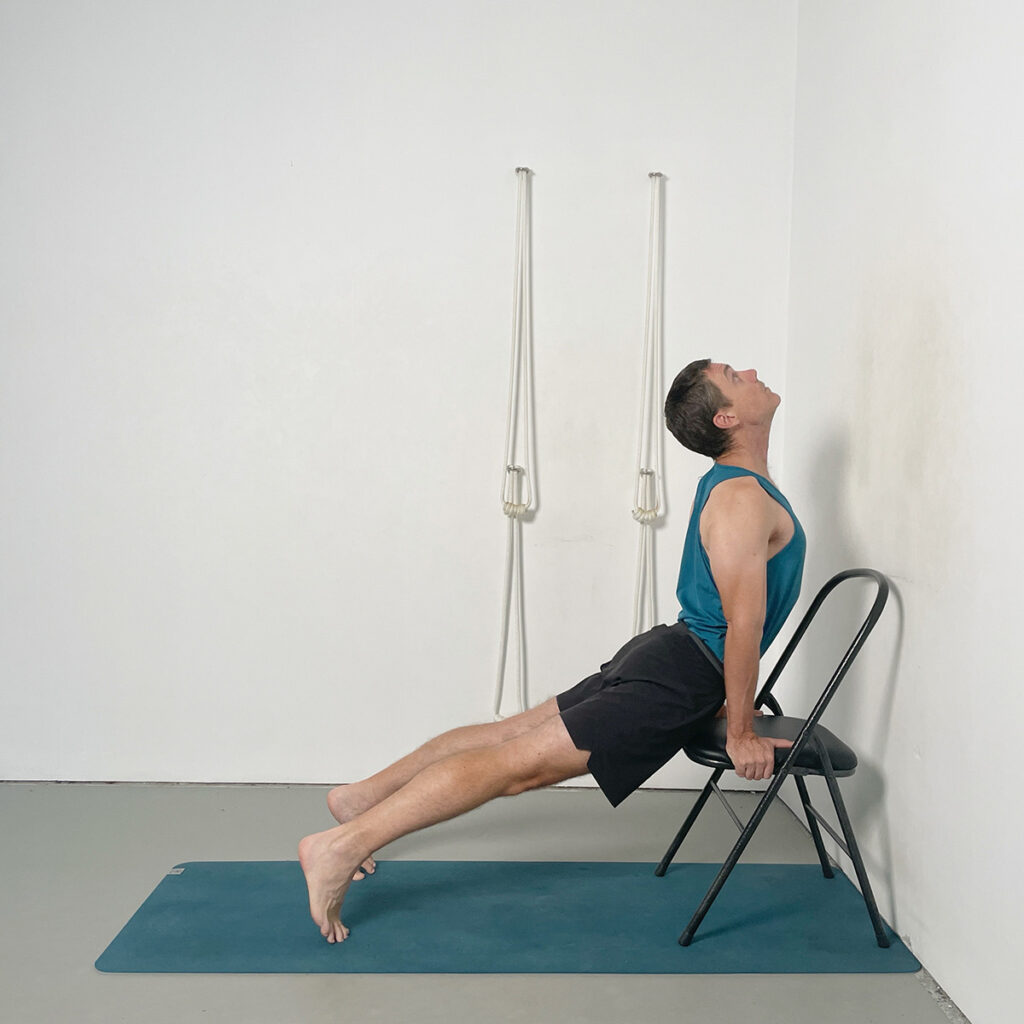
This supported variation of Urdhva Mukha Svanasana improves mobility and elasticity throughout the entire spine. Rather than allowing the lower back to dominate the backbend, this approach emphasises lift through the collar bones and engagement of the upper thoracic region. By pressing firmly into the chair and consciously moving the shoulder blades into the body, the chest is encouraged to move forward and upward without collapsing into the lumbar spine. The pose teaches how to distribute extension evenly – from pelvis to upper back – helping to restore balanced spinal curves and reduce the tendency for stiffness in the mid-back or compression in the lower back. When the thoracic spine participates fully, the neck and lumbar region remain more protected and aligned.
Instructions:
- Place the back of the chair firmly against the wall.
- Position the heels of the hands on the seat, fingers wrapping securely around and under the sides of the chair for a stable grip.
- Begin in a position similar to Downward Facing Dog: press the thighs and pubic bone back, and move the collar bones away from the hands.
- Maintain this collar bone lift as you bring the shoulders forward over the wrists and begin lowering the pelvis toward the chair.
- Keep the hands pressing firmly down, using that action to lift the collar bones and prevent collapse in the lower back.
- Straighten the knees and ensure the chest moves fully through the arms (briefly bend the elbows if needed to reposition).
- Roll the shoulders back and move the shoulder blades into the body, lifting the chest upward rather than simply arching the lower back.
- Allow the biceps to turn outward, supporting shoulder blade integration and descent of the trapezius.
- Lift the head only as far as you can while keeping the chest and chin lifting together, avoiding compression in the neck.
- Press back with control to return to the starting position.
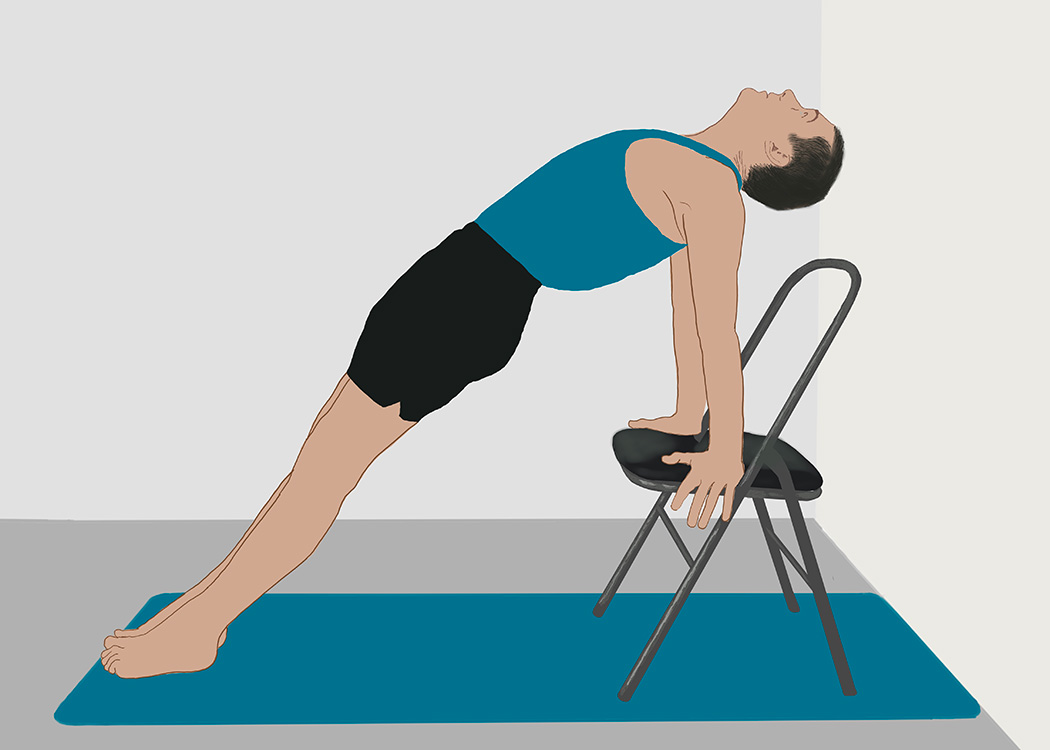
Pose 7 – Purvottanasana with Chair (Posterior Strength & Front-Body Opening)
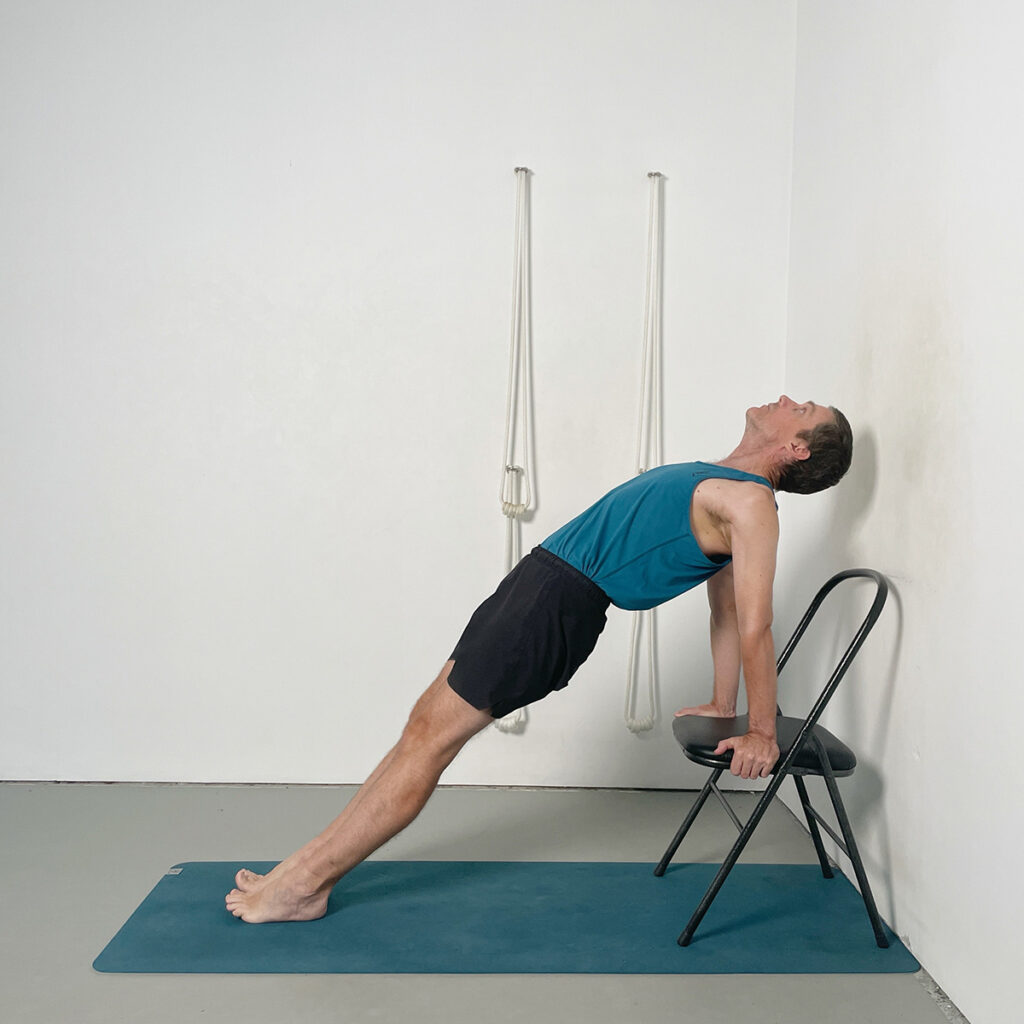
This supported variation of Purvottanasana strengthens the back body while opening the front of the chest and shoulders. Strong posterior muscles – including the gluteals, hamstrings, and upper back – are essential for maintaining an upright posture. Without this strength, attempts to “open the chest” can collapse into the lower back or strain the neck. By pressing firmly through the hands and heels to lift the hips, this pose develops strength along the back of the body while encouraging lift through the collar bones and sternum. The result is a balanced integration of strength and mobility: the back body supports the opening of the front body, allowing the chest to rise without compressing the lumbar spine.
Instructions:
- Sit on the chair with knees bent and feet flat.
- Turn the hands so the heels of the hands press firmly into the seat, fingers pointing forward along the sides of the chair.
- Shuffle forward until the sitting bones come just over the edge of the seat, with the tailbone still lightly supported.
- Straighten the legs and bring the feet together, keeping the balls of the feet lifted initially.
- Press the hands down, roll the shoulders back, and lift the area where the collar bones meet the sternum.
- Without losing this lift, press through the heels and lift the hips forward and upward.
- Allow the balls of the feet to come down as the hips rise.
- Move the shoulder blades into the body and continue lifting the chest while keeping the trapezius descending.
- Keep the abdomen releasing downward as the sternum lifts upward, avoiding compression in the lower back.
- Lower with control and return to seated.
Pose 8 – Plank with Blocks (Core Stability & Spinal Support)
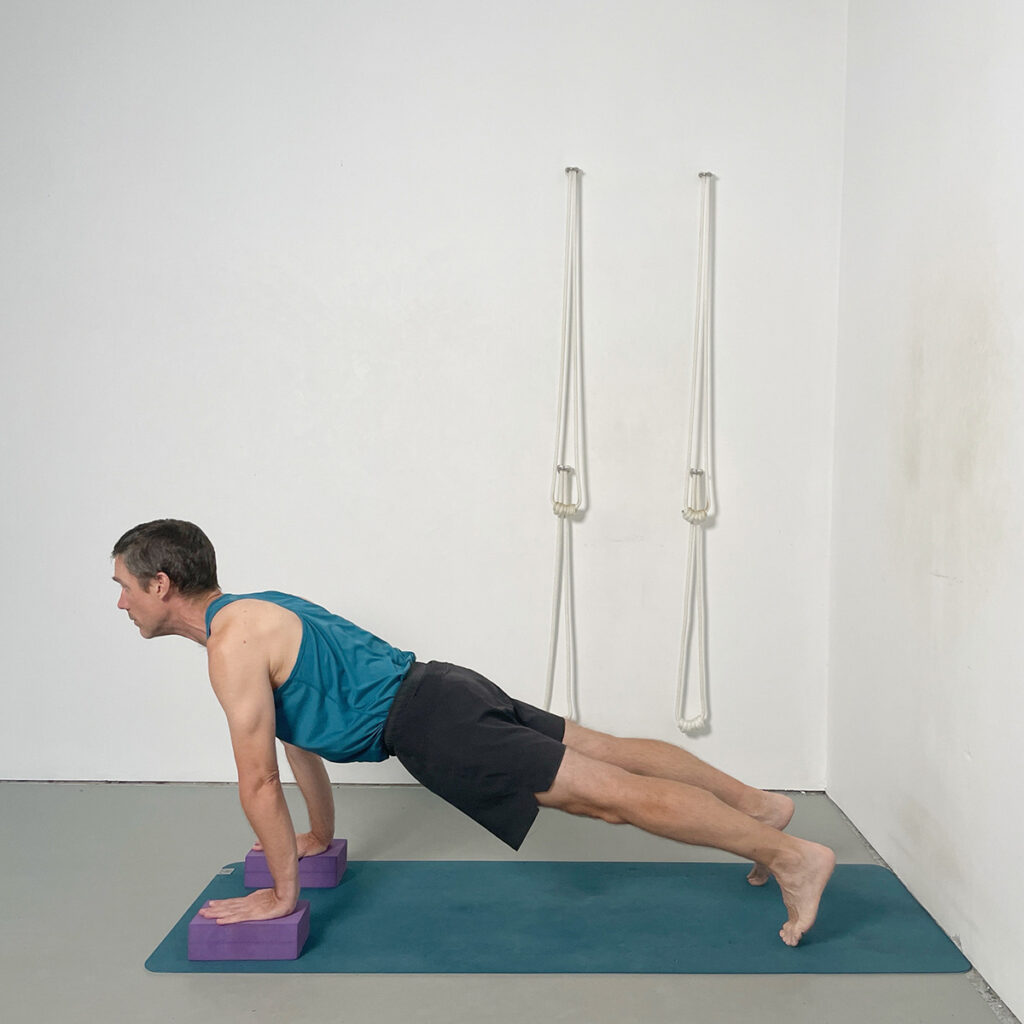
Core strength plays a fundamental role in maintaining healthy posture. While leg strength lifts the spine and upper back mobility allows the chest to open, the deep abdominal muscles help stabilise the lumbar region and prevent the pelvis from collapsing under the weight of gravity. A well-functioning core supports the natural curves of the spine, reducing excessive compression in the lower back and limiting strain in the neck and shoulders.
This variation of Plank Pose, practiced with the hands on blocks, develops that deep stabilising strength. By aligning the body in one long line and drawing the tailbone gently inward and downward, the abdominal wall activates to support the spine from within. Rather than gripping superficially, the work is deeper and more structural – reinforcing the relationship between pelvis, abdomen, and rib cage so upright posture can be sustained without tension.
Instructions:
- Place the hands on blocks and begin in a position similar to Downward Facing Dog.
- Press the thighs back initially to lengthen the line from wrists through shoulders to hips.
- Move forward into Plank, bringing the shoulders over and slightly beyond the wrists so the pelvis can align with the body.
- Firm the front thighs and draw the tailbone gently inward and downward.
- Allow the abdominal wall to engage naturally, supporting the spine without gripping or hardening excessively.
- Ensure the body forms one straight line from shoulders through hips to heels.
- Guide the sternum forward away from the navel, maintaining lift through the chest without dropping the pelvis.
- Keep the neck neutral, gaze slightly forward and down.
- Press back with control to exit the pose.
Pose 9 – Chatushpadasana (Supported Bridge for Strength & Chest Opening)
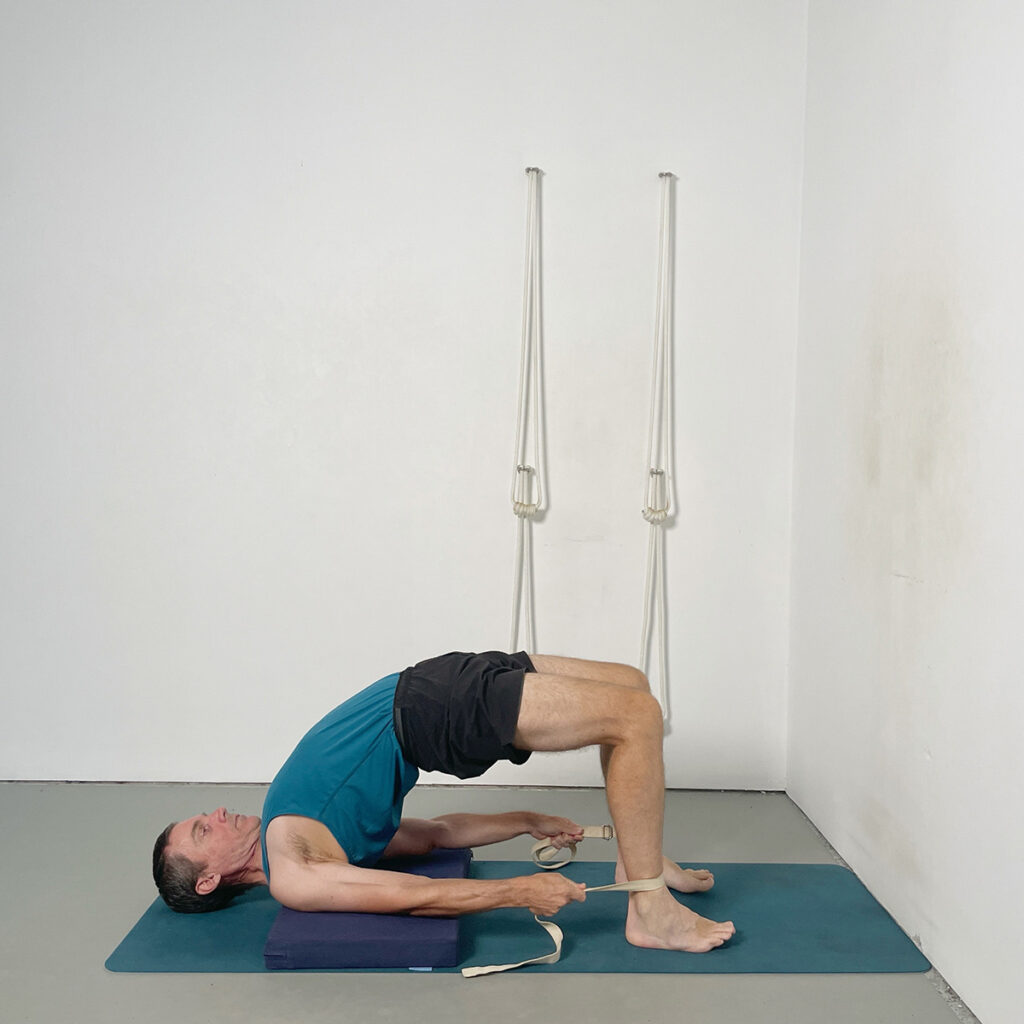
This supported variation of Chatushpadasana strengthens the buttocks and legs while gently opening the chest and upper spine. Unlike a strong backbend, the blankets provide support beneath the shoulders, allowing the lift of the pelvis and chest to feel stable and sustainable rather than forceful. Pressing the feet firmly into the floor activates the gluteal muscles and hamstrings – essential contributors to upright posture – while the action of the shoulders and elbows pressing down encourages lift through the sternum. The pose integrates lower-body strength with upper-body opening, reinforcing the balanced relationship between legs, pelvis, spine, and chest. As a concluding posture in the sequence, it brings strength and mobility together while gradually settling the nervous system.
Instructions:
- Stack three neatly folded blankets and lie back so the tops of the shoulders rest about 2–3 cm from the blanket edge, head on the floor.
- Place a belt across the fronts of the ankles, holding the ends in your hands so you can gently pull against the ankles without gripping the feet.
- Keep the feet hip-width and parallel, inner edges of the feet aligned.
- Press the feet firmly into the floor and lift the hips upward.
- As the hips lift, tuck the shoulders under slightly and press the inner feet down.
- Gently resist the outer ankles into the belt while pulling back with the belt — this opposition helps the hips lift higher and steadier.
- Press the elbows into the floor to assist the lift of both hips and chest.
- Add a further action by pressing the outer shoulders down, lifting the shoulder blades fully off the blankets.
- Bring the sternum toward the chin without tightening the throat.
- Lower with control, maintaining steadiness in the breath.
Improve Your Posture with Structured Iyengar Yoga
Continue your posture journey with the full Yoga for Poor Posture course.
These carefully structured classes help you open the chest, strengthen the upper back, and restore healthy spinal alignment through clear, methodical instruction.
Your membership includes full access to this course, over 900 on-demand classes, and Yoga Selection’s entire library of structured yoga courses.
Clear Instruction. Intelligent Sequencing. Iyengar Yoga for Every Body.
Deepen Your Practice: 8-Part Yoga for Poor Posture Course
The sequence above introduces several important principles for improving posture — including strengthening the legs and core to support the spine, improving mobility in the shoulders and thoracic spine, and learning how the chest can lift without creating strain in the lower back or neck. These techniques form the foundation of a healthy and sustainable upright posture.
For those wishing to explore this work in greater depth, our 8-part Yoga for Poor Posture course develops these ideas through a carefully structured series of classes. Each session focuses on a different aspect of postural improvement, helping you gradually build the strength, mobility, and body awareness needed for long-term change.
What You’ll Learn in the 8-Class Posture Course
Class 1: Yoga Poses Using a Doweling Prop

Class 2: Yoga Poses for Correcting Poor Posture
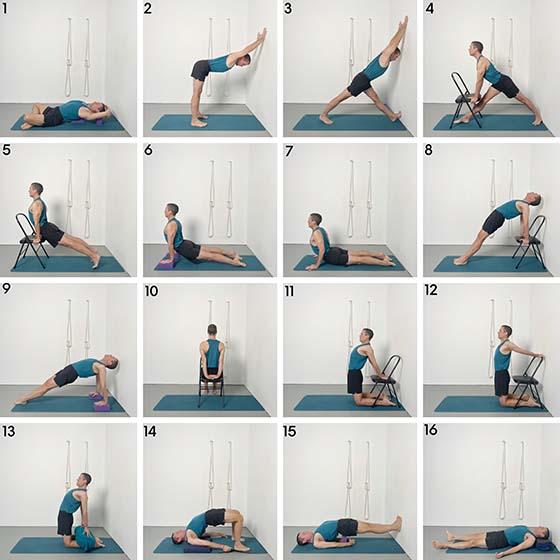
This class focuses on back extension poses from the backbend asana group to counteract rounded shoulders, collapsed chest, and forward head posture. These poses help mobilise the upper thoracic spine while drawing the shoulders back and down, encouraging the shoulder blades to settle more naturally into the body. Practiced regularly, they improve chest opening and reduce strain in the neck and upper back that often develops from prolonged sitting.
Class 3: Core Strength for Spinal Stability

This class develops strength in the abdominal and core muscle groups that stabilise the spine, pelvis, and shoulder girdle. Poses such as Paripurna Navasana, Urdhva Prasarita Padasana, Plank, Vasisthasana, and Chaturanga Dandasana strengthen the deep support structures of the torso, helping the spine remain upright and balanced against gravity. By reinforcing this central support system, the practice improves spinal stability and helps prevent the pelvis from collapsing or the lower back from becoming overloaded.
Class 4: Standing Poses and Backbends with a Looped Belt
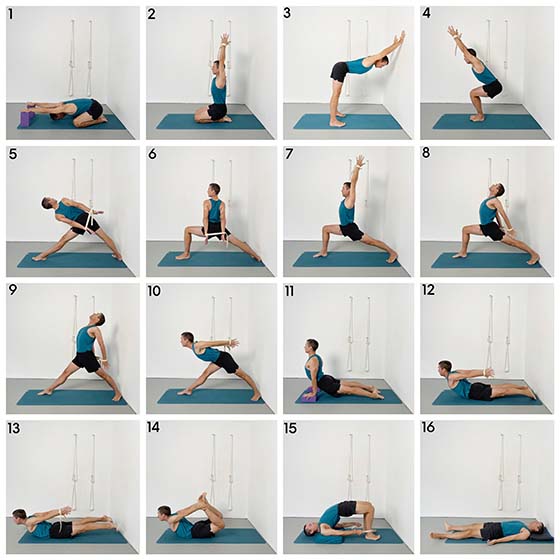
This class combines energising standing poses with introductory backbends to further develop the chest opening and shoulder work introduced earlier in the course. A looped belt around the arms is used to help draw the shoulders back and encourage the shoulder blades to move more effectively into the body. Standing poses build strength and stability in the legs while backbends such as Urdhva Mukha Svanasana, Salabhasana, and Dhanurasana improve mobility in the chest and upper spine, helping restore balance across the front and back of the body.
Class 5: Yoga for the Upper Back
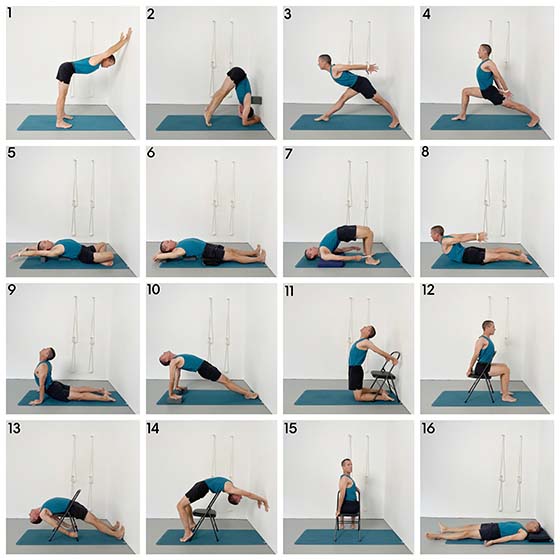
This class focuses on improving mobility and strength in the thoracic spine – a region that commonly becomes rounded through poor posture and prolonged sitting. The sequence combines chest-opening poses with strengthening work for the muscles of the upper back, helping counteract excessive forward curvature and restore balance across the shoulder girdle. With regular practice, these poses improve postural awareness and support a more upright, stable spine.
Class 6: Yoga for the Upper Back and Shoulders
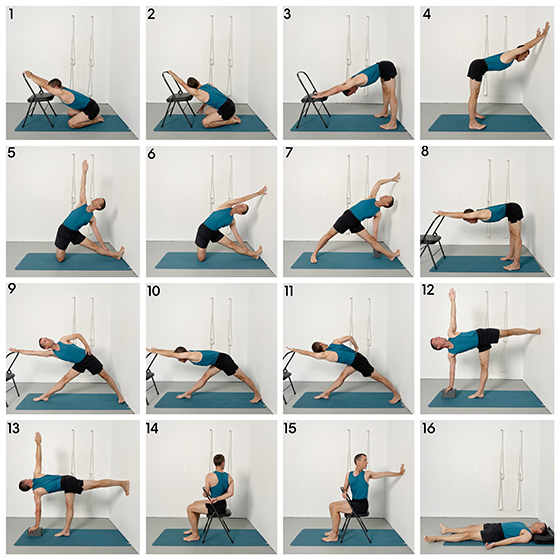
This class explores the close relationship between the neck, shoulders, and upper back. The sequence targets the thoracic spine and shoulder girdle with poses that improve strength, mobility, and stability while reducing tension around the base of the neck. Twisting variations are included to help release stiffness in the upper back and shoulders, supporting healthier movement patterns and improved postural balance.
Class 7: Yoga Poses for Office Workers
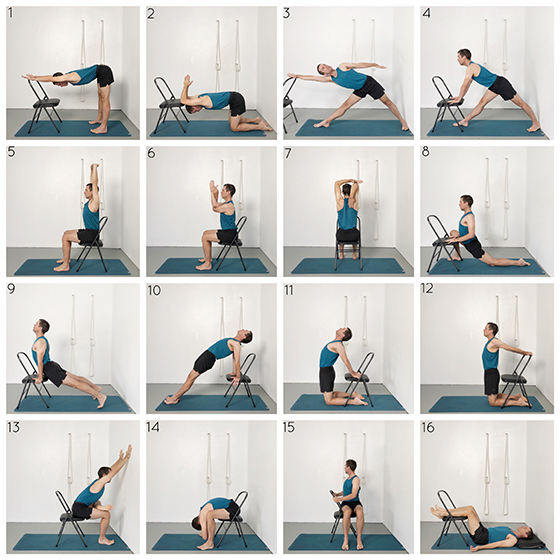
This class addresses the postural challenges created by prolonged desk work and computer use. The sequence focuses on opening the chest, restoring length to the thoracic spine, and releasing tension from the shoulders, neck, and wrists – areas commonly affected by sustained sitting and keyboard use. By helping reposition the spine into a more upright alignment, the practice can improve comfort, breathing, and overall concentration during the working day.
Class 8: Supported Yoga for Chest and Upper Back Opening
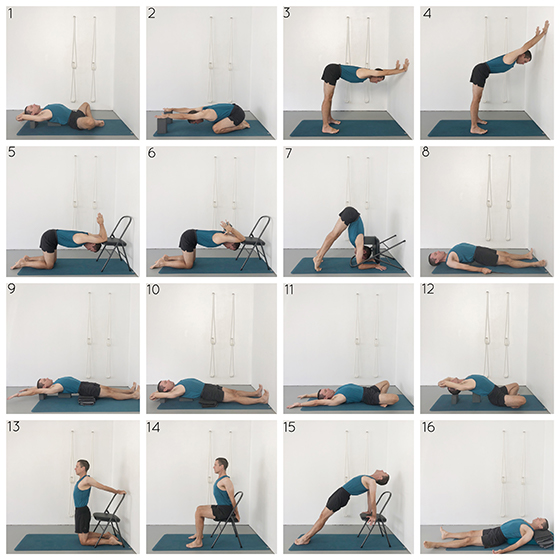
This class uses a chair and carefully placed blocks to create supported poses that open the shoulders, chest, and thoracic spine. Reclining variations help release stiffness from the upper back while encouraging the shoulder blades to settle more naturally into the body. These supported techniques allow the chest to open without strain, reinforcing the postural improvements developed throughout the course.
Embrace Better Posture and Well-being with Yoga
If you would like to explore these techniques in greater depth, the Yoga for Poor Posture course provides a structured program to help you progressively improve strength, mobility, and postural awareness. Each class builds on the last, guiding you step-by-step toward a healthier, more balanced relationship between your spine, shoulders, and chest.
You can explore the full course here:
Frequently Asked Questions About Yoga for Improving Posture
Can yoga really improve posture?
Yes. A well-structured yoga practice can significantly improve posture by addressing the underlying causes of poor alignment. Many postural problems arise from a combination of stiffness in the chest and upper back, weakness in the legs and spinal muscles, and reduced awareness of how the body is positioned. Yoga works on all of these elements simultaneously, helping restore mobility to the thoracic spine while strengthening the muscles that support an upright position.
Which yoga poses are best for improving posture?
Poses that open the chest, strengthen the upper back, and stabilise the core tend to be the most effective for improving posture. Back extension poses, chest-opening poses, and core strengthening exercises are particularly useful. Standing poses that strengthen the legs are also important because strong legs help support and lift the spine from its base.
How often should you practice yoga to improve posture?
Consistency is more important than intensity. Practicing a short sequence two to four times per week can begin to improve postural awareness and muscular balance. Over time, regular practice helps the body adopt healthier movement patterns so that improved posture becomes more natural and sustainable.
Can yoga help with rounded shoulders and forward head posture?
Yes. Rounded shoulders and forward head posture are commonly caused by tight chest muscles and weakness in the muscles of the upper back. Yoga poses that open the chest while strengthening the shoulder blade muscles can help restore balance across the shoulder girdle and encourage the head and neck to return to a more natural alignment.
Is yoga helpful for people who sit at desks all day?
Yoga can be especially beneficial for people who spend long hours sitting at desks or working on computers. Prolonged sitting often leads to stiffness in the thoracic spine, tightening across the chest, and tension in the neck and shoulders. Yoga helps counter these patterns by restoring mobility to the upper back and strengthening the muscles that support upright posture.
How long does it take to see improvements in posture?
Some people notice improvements in how their body feels after only a few sessions, particularly if stiffness in the chest or upper back begins to release. However, lasting improvements in posture usually develop gradually through regular practice as strength, mobility, and body awareness improve over time.
Do you need to be flexible to practice yoga for posture?
No. Yoga sequences designed for posture improvement typically include adaptations and props that allow people with different levels of flexibility to participate safely. In fact, many people begin practicing yoga specifically because they feel stiff or restricted in the shoulders, back, or hips.
What causes poor posture?
Poor posture is usually the result of a combination of muscular imbalance, reduced mobility, and habitual movement patterns. Long periods of sitting, particularly when working at desks or using computers, can lead to tightness across the chest and weakness in the muscles of the upper back and core. Over time this imbalance can cause the shoulders to round forward, the thoracic spine to become excessively curved, and the head to move forward of the body.
Can yoga help reduce upper back rounding (kyphosis)?
Yoga can be very helpful for reducing mild postural rounding of the upper back. Poses that open the chest and strengthen the muscles of the upper back encourage the shoulder blades to settle more naturally into the body. When combined with improved mobility in the thoracic spine and strengthening of the legs and core, yoga can gradually restore a more balanced and upright alignment.
What part of the body is most important for good posture?
Good posture depends on the coordinated work of several areas of the body rather than a single muscle group. The legs provide a stable base that supports the lift of the spine, the core muscles stabilise the pelvis and lumbar region, and the muscles of the upper back help position the shoulder blades so the chest can open naturally. When these areas work together, the spine can maintain its natural curves without excessive strain.
Take Your Posture Practice Further
Improving posture is rarely the result of a single exercise or class. It develops gradually through consistent practice that restores mobility to the chest and shoulders while strengthening the muscles that support the spine. Practicing sequences such as the one above can begin to counter the effects of prolonged sitting and habitual rounding of the upper back.
If you would like to explore this work in greater depth, the Yoga for Poor Posture course on Yoga Selection expands on these ideas through a structured series of classes designed to improve spinal alignment, strengthen the upper back, and build long-term postural awareness.
Explore Specialised Yoga Courses at Yoga Selection
The Yoga For Correcting Poor Posture classes discussed in this article can be found on yogaselection.com. Yoga Selection is a comprehensive online platform offering a wide range of yoga classes, courses and resources, including specialised courses targeting specific regions of the body.
Poor postural habits can sometimes contribute to discomfort in the lower back. If you are experiencing pain, our Iyengar Yoga for Lower Back Pain guide may be helpful.
In some cases tight hips and spinal compression can irritate the sciatic nerve. Our Yoga for Sciatica Relief article explores this in detail.
As a Yoga Selection member, you gain unlimited access to our extensive video library, featuring over 900 on-demand classes. Additionally, explore a diverse range of courses, with two new videos released every week.
Experience the flexibility of joining live classes in real time, allowing for personalised guidance and support. Immerse yourself in a vibrant community that nurtures your growth and provides valuable resources for your yoga practice.
Improve Your Posture with Structured Iyengar Yoga
Continue your posture journey with the full Yoga for Poor Posture course.
These carefully structured classes help you open the chest, strengthen the upper back, and restore healthy spinal alignment through clear, methodical instruction.
Your membership includes full access to this course, over 900 on-demand classes, and Yoga Selection’s entire library of structured yoga courses.
Clear Instruction. Intelligent Sequencing. Iyengar Yoga for Every Body.
Continue Exploring with Yoga Selection
- → Iyengar Yoga for Beginners – A structured starting point for building clarity and confidence.
- → Yoga at Home – Establish a steady, sustainable home practice.
- → Yoga for Stiff Bodies – Supported sequences designed to improve mobility safely.
- → Iyengar Yoga for Back Care – Develop strength and stability to support spinal health.
Share:
Rod Stennard – Founder of Yoga Selection
Rod Stennard is the founder of Yoga Selection, the first online yoga platform dedicated entirely to Iyengar Yoga. A certified Iyengar Yoga teacher since 2002, Rod has practiced yoga since 1992 and studied under senior teachers from around the world, including members of the Iyengar family in Pune, India.
Rod launched Yoga Selection in 2016 to bring structured, high-quality Iyengar Yoga training to a global audience. As a pioneer in the field of online yoga education, he is passionate about making this method accessible to all, through rigorous, inclusive, and thoughtfully designed classes. His work continues to support students of all levels in over 50 countries.